Say you want a portfolio of websites that make money as passively as possible.
Display ads are about as passive as it gets. You build something people already search for, you get accepted to a network, and the money shows up whether or not you opened your laptop.
So is that still realistic in 2026? Or did the door quietly shut while everyone was busy arguing about AI?
I spent most of last week on it. None of these networks publishes a client list, so I rebuilt all four from the transparency files the ad industry forces them to publish, then checked every single domain's own ads.txt to confirm it was still live.
Databases are available in SYD Pro, but you can build your own easily!
27,637 total sites. All earning from display ads as you read this.
Short version, it's still possible. Plenty of them are small and low-competition enough to compete with, and a lot of them got in this year.
Fun Facts about Cash-flowing Websites
6,699 of those 27,637 sites are directories, so roughly a quarter (~24%).
I also found that:
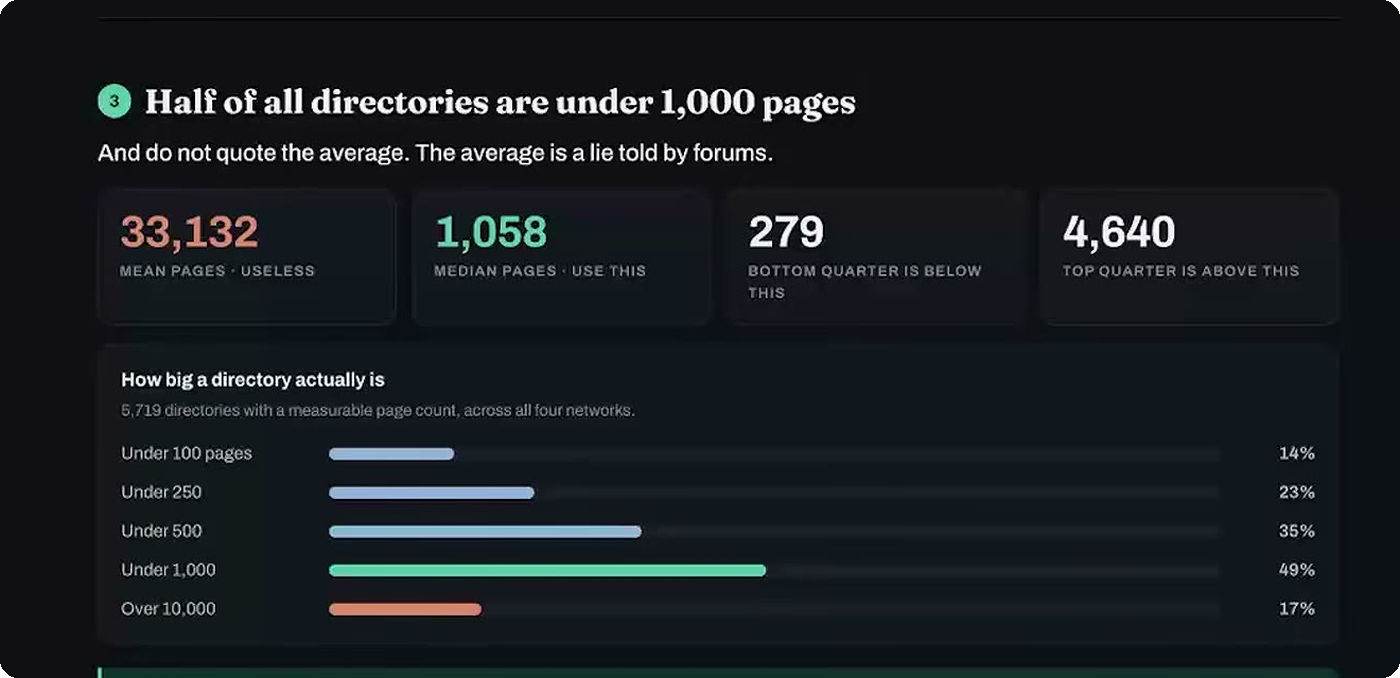
821 directories run fewer than 100 pages. You don't need a big directory to get substantial traffic.
2,695 are one person's only website. No company, no team, no portfolio.
58% monetize with display ads and nothing else. Affiliate is the most common second monetization stream.
Only about 8% sell sponsored or featured listings, which is the exact thing most people picture when they imagine a directory making money.
40% of Raptive is food and recipe blogs. By a long way the most common kind of site on there.
The biggest portfolio in here owns 118 sites, and 111 of them are forums. Beer and wine making, flashlights, disc golf, long range hunting. Completely all over the place.
An observation on the biggest portfolios
I keep coming back to the companies/people who own the largest portfolio of monetized websites. What are they actually doing?
Cultured Media, the company that owns 118 sites (111 forum sites) isn't a one off.
The second biggest portfolio belongs to Savetz Publishing, 58 sites on Ezoic, and 46 of them are printables sites. Same template every time, different topic bolted on the front.
Here's one of the sites for example (they literally all look like this): biblecoloringpages.org
Then you go down the list to the people running ten or fifteen sites and it gets completely random. Directories, boring calculators and tools, comparison sites, food blogs, whatever stuck.
So what the top of the list has in common isn't a niche. It's a format. They found one shape that works and ran it across topics that have nothing to do with each other.
I'll be honest though, there's a lot of data in here and it is very easy to get lost in it. Plenty of correlation that isn't causation, and every one of these sites grew in its own strange way.
So the way I actually use it is simple. I go looking for low competition sites I could compete with today, or build something adjacent to.
Here are a couple I found. They're not all directories.
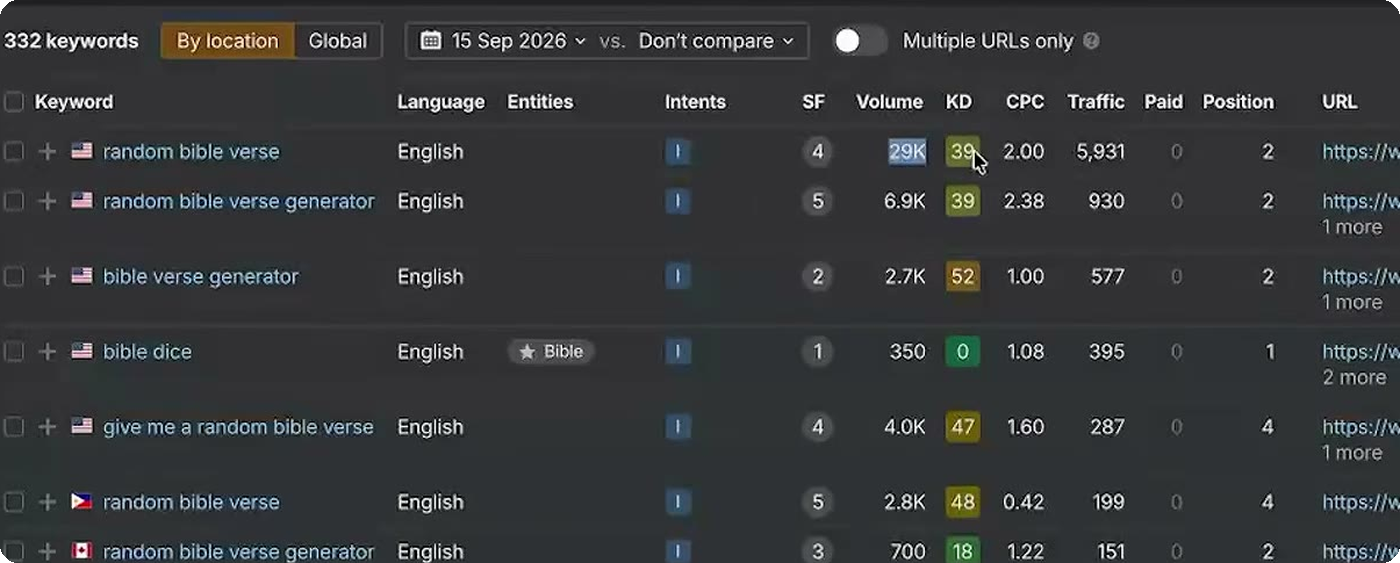
bibledice.com pulls 10,700 visits a month from basically one keyword
DR 1.3. Seven indexed pages. Nine backlinks I'd call real once you filter out the spam (and there is a lot of it).
That's the whole site. A button that gives you a random Bible verse.
83% of that traffic is US based, which is exactly what an ad network wants. It's been up over ten years and it's still a DR 1.3 (which I find genuinely funny).
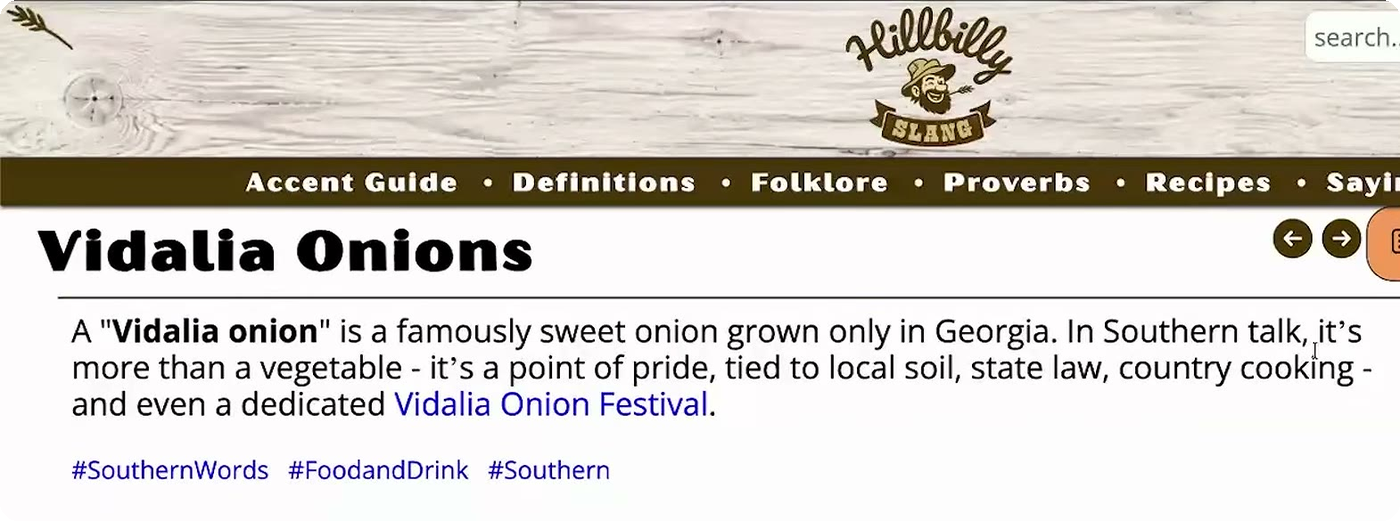
And then there's a dictionary of hillbilly slang
hillbillyslang.com. DR 6, about 2,800 monthly visitors, 488 pages, ranking for roughly 1,200 keywords with almost no competition on any of them (the difficulty scores are green the whole way down).
"Kitty corner" was the one that got me (it means diagonally across from, and I genuinely did not know that).
I could not have predicted this niche in a hundred years of brainstorming. Which is exactly why I go through a database instead of trying to think my way to an idea.
Ahrefs only ever shows you Google
Every number I just quoted came out of Ahrefs, and Ahrefs only counts Google organic. It misses Bing, AI citations, email and every social platform, which is why these traffic estimates run so low (sometimes by tens of thousands of visits).
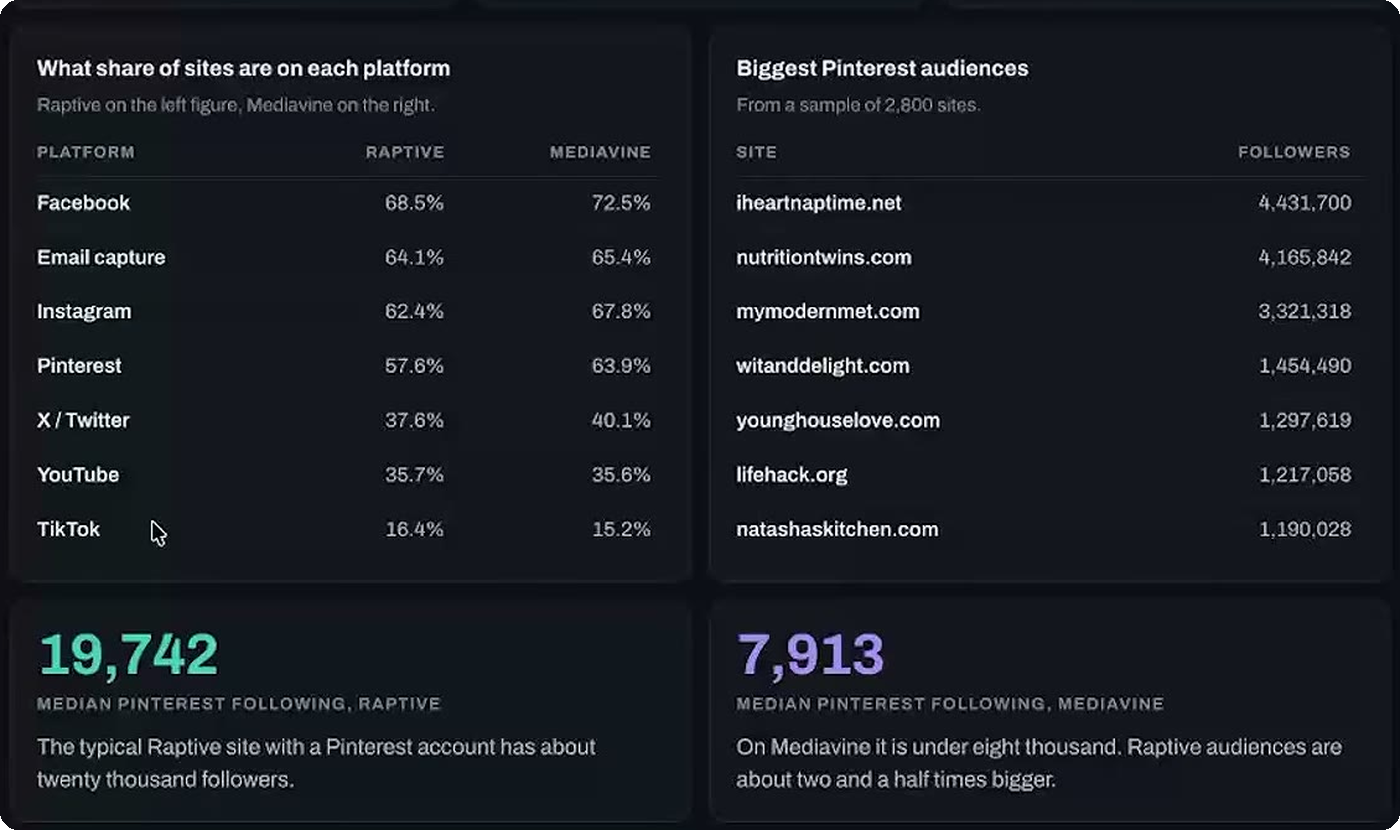
So the other thing I checked was social. One in five of these sites has no social account of any kind.
So where is the rest of that traffic coming from? Facebook, mostly. But Pinterest is the real sleeper.
I've known that for years and still never built one properly, which is embarrassing when I'm sitting on directories full of images and data that would repurpose into pins within a couple hours.
So that's my own to-do out of this. If there are communities already talking about your topic, go take some of that attention and point it at your site.
Which display ad network should you choose? And when?
On January 15th, Mediavine replaced its 50,000 session requirement with a revenue test (roughly $5,000 a year), and dropped the minimum for Journey, their on ramp for smaller sites, to 1,000 sessions a month.
A thousand sessions. Not pageviews. Sessions. If you've got 500 pages and each one pulls two visits a month, you're in.
That's the actual floor, and it's why 821 sites with under a hundred pages are sitting on these networks right now, quietly collecting.
Skip AdSense. I wouldn't even bother. The payout isn't worth the ad clutter that early.
Apply to Mediavine Journey at 1,000 to 3,000 monthly sessions. That's the first real door.
Apply to Raptive at 25,000. They dropped it from 100,000 monthly views, which is a big deal. Then just stay there.
One honest thing. Mediavine rejected one of my directories recently for not having enough blog content, so I need to add some articles and reapply. Journey still takes directories (they're just pickier about what surrounds the listings).
Worst they can say is no, and you can always apply again later.
Nearly 4 in 10 sites joining Raptive this year are directories
483 sites showed up in Raptive's seller file this year. 182 of them are directories.
That's 38%, against 29% of Raptive as a whole. So directories aren't just getting in, they're getting in at a higher rate than their share of the network.
One I liked: f1salaries.com. 234 pages, one person, joined in June. It's F1 driver salaries and contracts, which is public information anybody could have put in a table.
None of this makes the building part easier. You still have to pick something people search for, ship it, then do the boring maintenance for months before anything happens.
One last thing, because I don't want to oversell this
Everything above says these sites are reachable. It does not say they're the best thing you could be building.
Because if you ask me whether these are the best assets to own, the honest answer is not always. Display ads are one model out of many. Some of these have no moat at all, and a niche that's wide open today can crowd up in a year. There are directory models that monetize better and hold up better over five years.
What I do stand by is that display ads are the lowest hanging fruit for a first profitable website. The bar is reachable, the money is passive, and you never have to sell anything to anybody.
And the real lesson from those big portfolios isn't "go build a display ad directory." It's that they kept experimenting until one format stuck.
So treat this as one option on a long list, not an instruction to go build twelve of them. If you're still early, go experiment with all of it.
There's a lot more in here that I couldn't fit into the video. Hit reply and tell me what you want me to dig into next (I read every single one).